Session-Scoped Token Lifecycles in Third-Party Auth Flows and What Your Tests Must Track
A local stateful simulator can prove old tokens lose access.
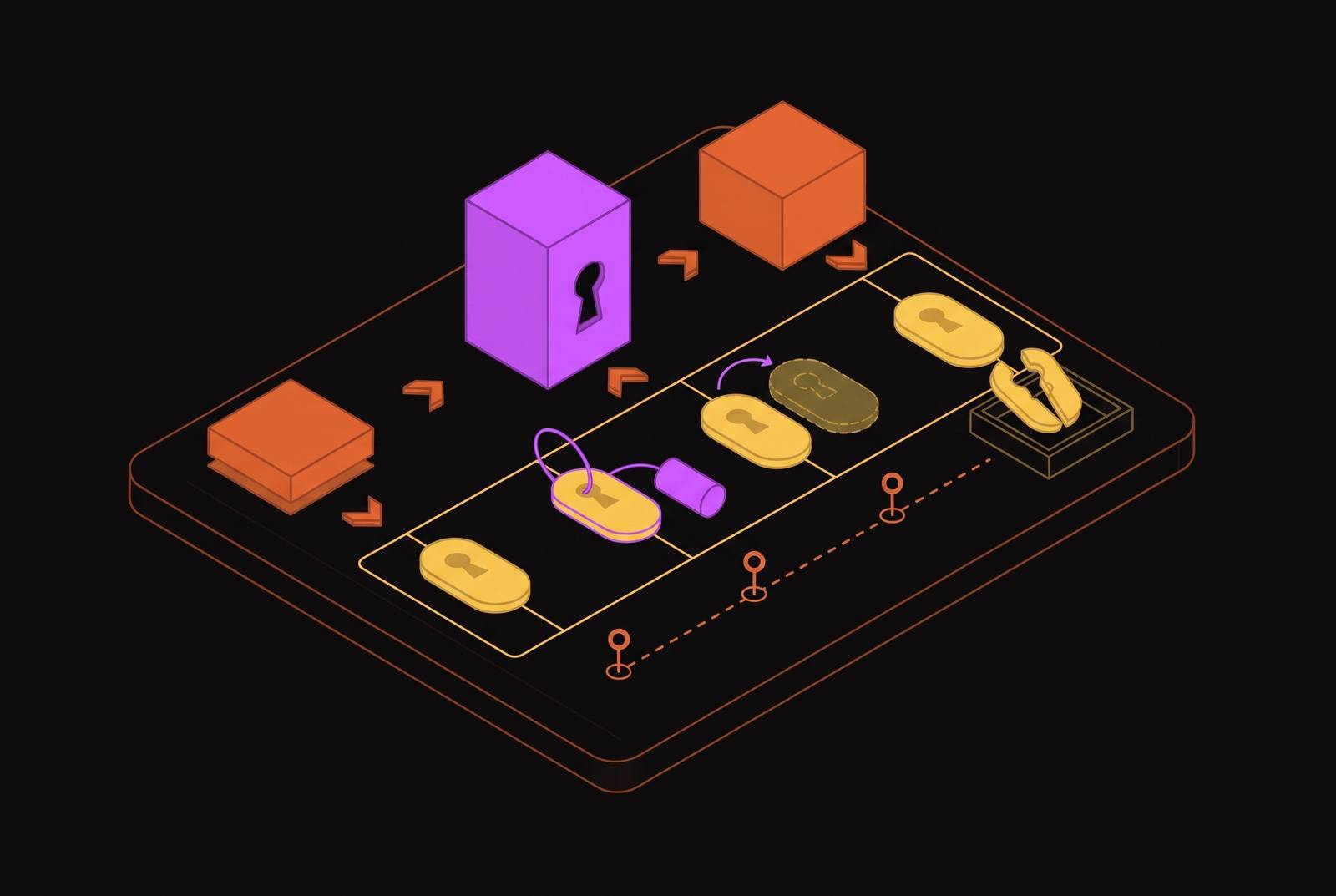
Integration testing against stateful APIs needs a test environment that remembers earlier calls and uses them to decide how to respond to later ones. For session-scoped tokens in third-party auth flows, a local stateful simulator lets tests cover issuance, use and expiry, rotation, and revocation without production credentials. The essential assertion is that earlier credentials lose access when the lifecycle requires it.
Why session-scoped tokens are not the same as user sessions
A user’s login status does not determine an OAuth token’s validity. A login session ages out with user activity, while a delegated token follows its issuance parameters, rotation state, and explicit revocation rules. These are separate forms of state. Logout or a password reset does not automatically invalidate a delegated credential unless the application handles that transition. A test that checks only whether the browser has returned to the login screen leaves that credential’s access unexamined.
The Klue-Salesforce incident illustrates the reach of that distinction. A compromised legacy credential allowed attackers to introduce unauthorized code into Klue’s integration service and harvest OAuth tokens connecting it to customer Salesforce accounts. Salesforce itself was not breached. The compromised trust relationship was between the integration’s tokens and customer data.
That distinction also applies within the token inventory. Access tokens are short-lived bearer credentials, while refresh tokens are long-lived credentials that are managed through rotation. ID tokens are consumed once at the client and are not for API authorization. Session tokens are browser cookies whose state is kept on the server. Treating these four classes as interchangeable obscures the different events that should end their usefulness.
The four lifecycle stages where state actually changes
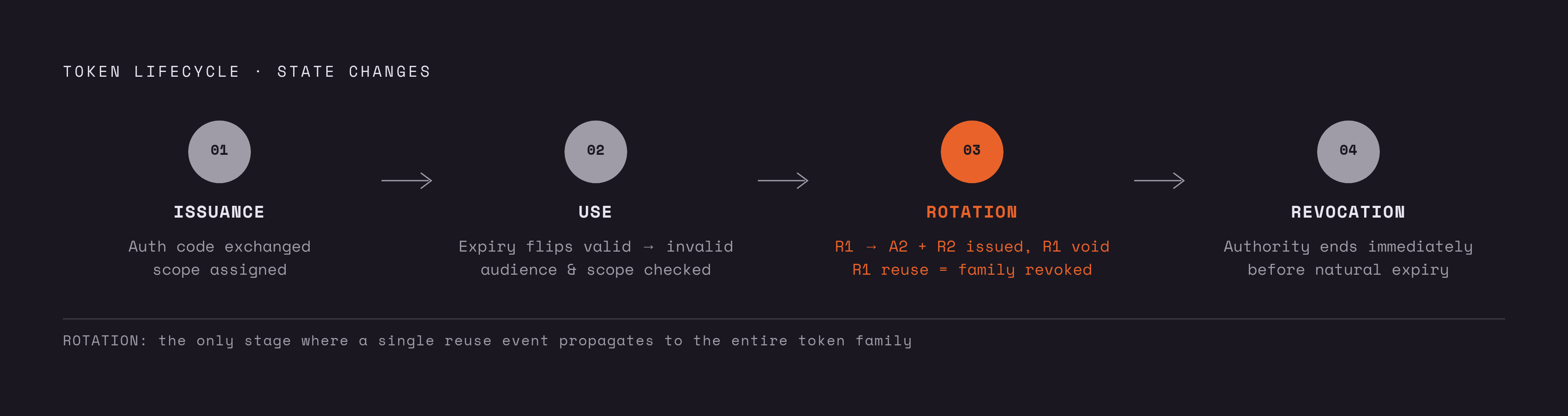
Issuance establishes the initial authority of a token. The authorization code flow is its entry point, but successful exchange alone does not establish that issuance is safe. Authorization codes must be short-lived, single-use, and bound to both the client and redirect context. Scope sets the boundary of delegated access. Granting overly permissive scopes at this stage creates authority that later token acceptance checks cannot repair.
Use is the stage at which the resource server decides whether that authority still applies. Expiry belongs here as a change from valid to invalid. Signature validation is only one acceptance condition. The server must also distinguish correct scope from insufficient scope, recognize revoked and expired credentials, and reject tokens from another authorization server or intended for another resource server.
Rotation changes which refresh credential can be used to keep access. In the sequence described by the OAuth 2.1 IETF draft, presenting R1 produces a new access token A2 and refresh token R2 while invalidating R1. Presenting R2 then produces A3 and R3 while invalidating R2. Reuse of an invalidated predecessor is a token-theft signal that should invalidate the entire token family.
Revocation ends a token’s authority before it would expire on its own. Revoking an access token must make the resource server reject it, while revoking a refresh token must prevent new access tokens from being obtained. The required change is immediate. Logout, password reset, and role change are independent triggers whose effects need to be established, rather than inferred from a successful response to the triggering action.
Why happy-path tests miss the transitions that matter
A successful browser login says little about these later decisions. The same flow can pass while state parameter validation is ignored, authorization codes remain replayable, audience checks are absent, and refresh token rotation is unenforced. None of those failures necessarily interrupts the first login.
A PaymentIntent integration illustrates the same structural failure outside authentication. A pipeline mocked POST /v1/payment_intents, asserted 200, and passed, but the first real checkout in staging failed because the handler never stored the PaymentIntent ID. The second step of the webhook path read undefined. Because the test never modeled cumulative state, it could not expose the missing link between the two calls.
In an auth flow, accepting R2 likewise does not show that R1 will be rejected. A logout response does not show whether a token issued earlier can still reach protected records. OWASP API2:2023 Broken Authentication covers implementation flaws that let attackers compromise authentication tokens or assume another user’s identity. Lifecycle gaps belong within that security concern.
How to test APIs where order of operations matters
Stateful test infrastructure must remember what happened and use that history to determine the next response. A stateless mock that returns a fixed body for each matching request can check endpoints on their own, query parameters, or one failure at a time. It cannot establish a history-dependent access decision. For lifecycle coverage, the environment must represent whether a token is issued, rotated, expired, or revoked, and update that state as operations occur.
Rotation makes the required mechanism concrete. A simulator issues R1 and records it as valid, then records R2 as valid and R1 as invalidated when rotation occurs. A later presentation of R1 must produce an error. Where token-family invalidation is required, that reuse must also change the family’s state, so subsequent calls reflect the security response.
Revocation also needs that memory to carry over from authorization to resource access. A token that worked before revocation must return 401 afterward, every time it is used. An empty sandbox cannot demonstrate which records a scoped token can reach or whether revocation removes that access. With records already in place, tests can check both the token endpoint and which records the token can reach.
A simulator can keep its token state machine consistent and still use rotation semantics that differ from those of the real provider. It must be validated against the live API. Without that check, a suite can pass even as the test environment’s rules grow apart from how the integration works.
The minimum test checklist for each lifecycle stage
For issuance, test public clients with PKCE using S256 and require its enforcement, then submit plain and require rejection in the production profile. Exercise look-alike redirect URIs, subpath variants, subdomain wildcards, and open-redirect variants, and require each to fail exact matching. Exchange the same authorization code twice. The second exchange must fail, as must an exchange after code expiry. Tamper with the state parameter and require rejection, then request unauthorized scopes and verify that they are ignored or rejected.
For use, present a valid token with the correct scope and expect 200, then present a valid token with insufficient scope and expect 403. Let an access token expire and require 401 with invalid_token. Present a revoked token and require 401. A token issued by a different authorization server and a JWT whose payload has been tampered with must each receive the same response. Finally, present a token to the wrong resource server and require 401 for the audience mismatch, independently of signature validation.
For rotation, refresh with valid R1 and verify that the response contains both a new access token and new refresh token R2. Then retry the exchange with the old R1. It must be rejected, and its reuse must trigger token-family invalidation. Attempt a refresh after user logout and require rejection. Compare the refreshed token’s scope with the original and verify that refresh has not broadened the grant.
For revocation, revoke an access token and immediately present it to the resource server, which must reject it. Revoke a refresh token and attempt to obtain another access token, which must fail. Test each trigger driven by a user on its own, with credentials issued before it. After logout, the earlier token must be rejected, and after password reset, pre-reset tokens must be rejected. After a role change, pre-change tokens must no longer provide the old role’s scope.
RFC 9700, published in 2025, provides the current-practice baseline for evaluating the deployed OAuth profile. Tests should follow that profile and current best practice instead of older tutorials that use implicit grant or send secrets from a single-page application. Test output needs its own credential boundary. Do not log authorization codes, client secrets, access tokens, refresh tokens, ID tokens, or PKCE verifiers. Use generated transaction IDs and redacted fingerprints in reports instead.
Running lifecycle tests in CI without touching live credentials
Lifecycle tests belong in CI, but live authorization servers introduce rate limits, credential exposure, and flaky failures into routine runs. A stateful simulator running locally avoids those dependencies while preserving the sequence under test. No live credentials are needed for those runs. Validation of simulator behavior against the provider remains a separate fidelity requirement, rather than a reason to send every commit’s tests to a live endpoint.
To make runs predictable, set up tokens at known lifecycle stages before the tests run. Individual cases can receive a freshly issued token, one about to expire, an already rotated token, or an already revoked token without racing against real-time expiry clocks. Protocol checks can run on the local machine without network access. Mocked authorization servers are suitable for unit-level assertions about PKCE enforcement, state validation, and code replay rejection, while integration tests need the multi-call state machine.
The CI structure should reflect that division. Stateless protocol assertions can run in parallel across branches, while stateful rotation and revocation tests run serially with isolated token state for each test run. Isolation prevents one run’s revocation from contaminating another run’s expectations. Fault injection belongs in the same infrastructure so failure handling is exercised with lifecycle state intact. Scope enforcement and lifecycle checks should gate every commit, making the full sequence a release condition.
How AI agents change what token lifecycle tests must cover
LLM-driven agents using third-party APIs inherit the same credential risks as human-driven integrations, but they can also construct incorrect operations. Anthropic’s MCP, or Model Context Protocol, is a connectivity standard, while OpenAI’s function-calling API supports tool use for agents. Neither makes a tool schema an enforced contract for the model. An agent can produce incorrect parameter types, omit PKCE, or request the wrong scopes, turning an input construction error into an authentication or authorization failure.
An agent can call the rotation endpoint, receive R2, and then erroneously retry with R1. That retry has a security meaning beyond failure. Under the required reuse response, it is a sign of possible token theft and invalidates the token family, which changes what happens to later calls that rely on that family. A fixed-response mock cannot reproduce those consequences, while a live sandbox cannot reliably reproduce the sequence at the scale needed for agent evaluation.
Prompt injection is another way credentials can be misused. Attempts to make an agent send unauthorized API calls, extract data, or change records must be tested before production. The tests need protected resource state as well as token state. Without both, they cannot show whether the action the agent tried crossed the scope boundary or whether a revoked credential still gave access to records.
Examples of inputs in tool definitions can cut down on wrong token-related inputs before they reach the API. That documentation improvement addresses input construction, but it does not replace lifecycle assertions. A correctly formed request can still use an invalidated credential.