Replay Auth State Across Token Lifecycle Stages Without Hitting Production
A stateful simulator lets you test expiry, rotation, and revocation.
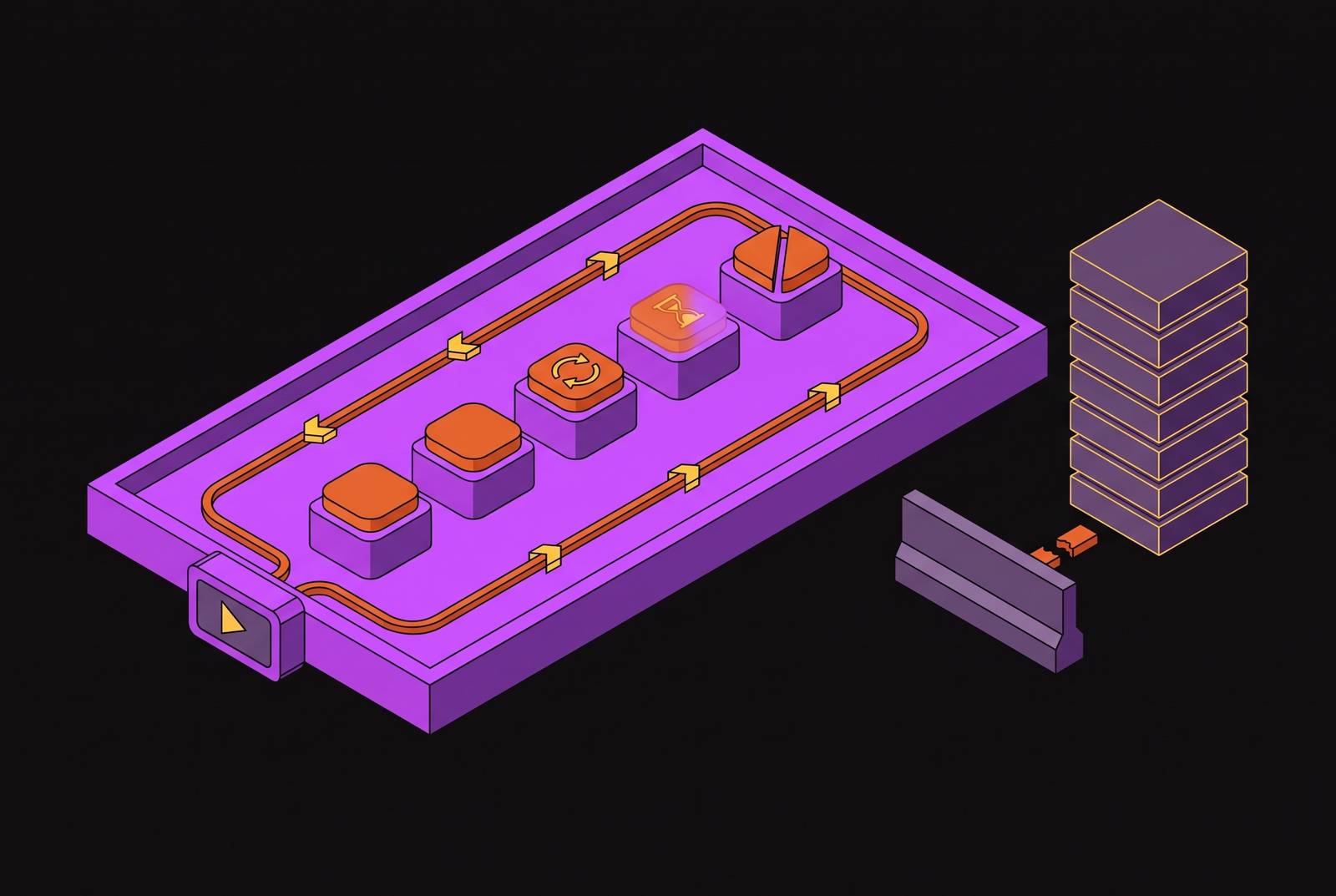
Integration testing against stateful APIs requires a simulator that preserves changes between calls, so tests exercise the consequences of earlier operations. For authentication, that means seeding and advancing tokens through distinct lifecycle stages. Local or CI replay can then test expiry, rotation, revocation, and audience enforcement without live credentials or production rate limits.
Why auth state is not a single boolean
A token that decodes cleanly and has a valid signature can still be expired, rotated, revoked, audience-mismatched, or not yet valid. The signature is only one validation layer. A fresh token has valid claims and can be accepted, while an expired token must be rejected because its exp has passed. A rotated token has been superseded, so its old copy must be rejected even before expiry. A revoked token has been explicitly invalidated server-side, regardless of its cryptographic validity.
Context and time impose further conditions on acceptance. A token issued for one service is not necessarily valid for another, even when both can validate its signature. A token that was correctly issued also cannot be used yet if its nbf is in the future. These conditions are distinct from expiry and revocation. Auth state therefore includes both a token’s claims and the server-side history on which continued access depends.
Expiry can return a 401 with a clear reason, while revocation can return the same status only after consulting a revocation list or token-store entry. Audience mismatch may return 401 or silently succeed if the receiving server does not validate aud. “Wrong audience accepted” describes a specific validation failure that a generic “JWT security failed” does not.
How most testing infrastructure collapses these stages into one
Standard test setups often make authentication a reusable precondition. They authenticate once, capture the resulting state, and use it throughout the suite. This supports happy-path tests without repeated login calls. However, it also fixes authentication at one point in its lifecycle, leaving later changes outside the test’s model. Successful reuse demonstrates that saved credentials work, leaving the application’s handling of their replacement or invalidation unverified.
Playwright’s storageState pattern illustrates this boundary. A setup project can authenticate and save state to a file, which subsequent UI or API tests reuse through APIRequestContext. Token-based APIs follow a similar pattern by capturing a login token and supplying it through extraHTTPHeaders. If the saved state outlives the token, tests begin returning 401s because the stored snapshot cannot advance itself.
A setup that checks freshness can see whether saved state still works and authenticate again when needed. That handles the fresh-to-expired boundary, but it does not exercise rotation, revocation, or audience mismatch. The distinction is between maintaining a precondition and testing it. A suite can extensively test application behavior behind valid authentication while leaving the authentication lifecycle itself uncovered. Adding a fixed auth response compounds that gap because no event in the test can change what later auth checks observe.
What a complete token lifecycle test matrix actually covers
A lifecycle matrix maps each token condition to the operations to test and the effects they should have. Its rows represent fresh, expired, rotated, revoked, audience-mismatched, and not-yet-valid tokens, with proof reuse where the design requires it. Its other dimensions include acceptance or rejection, subsequent requests, and changes to application state. Each intersection targets a distinct failure mode. Coverage includes the conditions themselves and the transitions that make an earlier credential behave differently.
For a fresh token, the expected cell is acceptance with the correct resource returned. For an expired token, it is rejection with the appropriate error and no database or queue mutation. The not-yet-valid case checks that the token is rejected before nbf. Rotation needs assertions for both copies because the old copy must fail while the new copy succeeds. Revocation instead tests whether explicit server-side invalidation overrides a token whose expiry and signature remain valid.
Audience mismatch adds a context boundary to the matrix. A token issued for Service A must not gain access when presented to Service B. Proof reuse tests a different boundary again. In DPoP or nonce-based designs, repeated proof identifiers must be rejected according to policy, and nonce reuse must respect the configured replay window.
Refresh tokens need their own linked entries. Rotation must issue a new refresh token and reject the old one on its next use, while reuse detection must trigger a security response beyond a silent 401. Concurrent refresh tests whether only one of two simultaneous calls succeeds. JWKS rollover adds a signing-key dimension. Tests must cover acceptance of the new key while the retiring key remains valid, followed by rejection of tokens signed with the retired key.
Rejection assertions extend beyond the HTTP response. The matrix must also check that databases, queues, audit events, and external side effects stay unchanged where they should. A 401 does not prove the request was harmless. An unauthorized request that still changes state is a separate bug, even when the response looks correct.
Why stateless mocks cannot represent lifecycle transitions
A stateless mock has no memory between calls. It can return a rejection for an expired-token fixture, but that response does not demonstrate a transition from valid to expired. Making acceptance depend on elapsed time requires a controllable clock or changing state, a structural requirement for the mock. A realistic error body cannot establish that the system reached the error for the right reason.
Revocation exposes the same limit through event history. A logout, admin action, or refresh-token reuse event changes a token’s status in a store. The next validation must read the status after that change. A fixed responder has no record to update. A test that passes against it cannot show that the operation that invalidated the token changed how later requests behaved.
Scripted response sequences can imitate an ordered exchange, but their behavior follows call position. Such sequences are fragile when tests run in another order or in parallel, and they do not compose across test files. They also fail to connect a mid-session revocation call to later validation. The gap between call order and causality allows response-shape tests to pass even when a handler never stored the issuance event that the next step needs.
How to test stateful APIs by holding and advancing auth state
Developers need a persistent auth state store that test calls can change. Rotation and revocation operations must change its entries so later requests see the result. Seeding supplies the complementary capability for targeted tests. A test can begin with an already expired, rotated, or revoked token without reproducing every preceding event. Seeds quickly put tokens in those conditions, while transition tests check that operations put them there correctly.
Time must also be under test control. A simulator needs a configurable notion of “now” so expiry and nbf checks do not depend on wall-clock delays or carefully precomputed timestamps. Audience enforcement must check aud against the recipient set in the configuration. For proof-based flows, a cache must track seen identifiers and reject reuse within the configured window. A revocation store must retain revoked token identifiers, or jti values, for the test session.
State that persists within a test must stay separate from the state of other tests. Parallel runs need their own stores so one run’s revoked token or used nonce cannot affect another. Horizontal scaling must preserve that separation across CI containers. Otherwise, concurrency changes the conditions being tested.
Behavioral fidelity is as important as state storage. A simulator can hide bugs if its expiry semantics differ from the provider’s or it accepts audiences the provider rejects. Continuous comparison with the real API is therefore necessary to catch drift. Fault injection extends coverage beyond token validity. Validation latency tests retry behavior, injected 429s test token-endpoint backoff, and injected 503s test how the application handles an unavailable revocation service.
Lifecycle replay in practice: Stripe, GitHub, and PayPal auth edge cases
Stripe illustrates why auth replay must remain distinct from operation replay. Its idempotency key protects state-changing operations against replay and retry. A simulator must enforce these independently. Passing an idempotency test does not establish that an invalid credential is rejected. The integration needs both rules represented without substituting one for the other.
Stripe’s payload versions add another state boundary around the authenticated integration. A breaking release moved shipping_details into collected_information.shipping_details, creating a need for fixtures on both sides of the migration. A webhook endpoint with a null api_version follows the account default. Replaying the “account default changed” transition tests payload drift that can occur without an application deployment, although it is not itself a token lifecycle stage.
GitHub presents a different separation between verification and delivery history. Its webhooks use X-Hub-Signature-256 with HMAC-SHA256, but failed deliveries are not automatically redelivered. Manual redelivery needs its delivery view or REST API. A simulator can retain the “delivery failed, awaiting manual redeliver” state without triggering real webhooks.
PayPal retries failed webhook deliveries multiple times over several days. Its relevant replay states include “delivery acknowledged” and “delivery pending retry,” allowing deduplication tests without waiting through real retry intervals. These delivery states share with token validity states the requirement for retained history. Across these integrations, a test must distinguish credential validation, replay protection, and delivery progress rather than flattening them into one successful response.
Integrating lifecycle replay into a CI pipeline
Lifecycle coverage belongs in the merge gate for changes to auth logic. A pipeline can start a stateful simulator as a service container and use its seed API during test setup. The seeded conditions include fresh, expired, rotated, revoked, audience-mismatched, and not-yet-valid tokens. Each test begins at its intended stage. Tests of rotation or revocation then make the state-changing call and assert how later requests behave.
Separate simulator containers keep nonce caches and revocation stores from colliding across runs. Within each run, assertions check that the response is as expected and that no forbidden side effects occur. Both determine the pipeline result. The pipeline exits 0 when all lifecycle cases pass and exits 1 when any stage produces an incorrect response or unexpected mutation.
Fault injection belongs in that same pipeline. Injected latency on token validation must check that retries do not make the same state-changing call again. An injected 429 on the token endpoint must test correct backoff, while an injected 503 on the revocation endpoint must test graceful degradation. Keeping them in the merge gate prevents resilience coverage from depending on a separate, occasional run.
A small deployment-time call to the provider’s sandbox adds a fidelity check against real token semantics. This is separate from the local lifecycle suite and does not require sending those tests to production. The distinction keeps the feedback loop controlled. Local fixtures test changes to the application as it is being developed, while checks against the sandbox show whether the simulator has drifted since the last release. Together, they catch expiry, rotation, revocation, and audience defects as merge-time failures before they become production incidents.