Grant-Boundary Fault Injection as the Quant Standard for Kalshi Bot Pre-Live Confidence
Backtests alone can't clear a Kalshi bot; stress its edge against fees and faults.
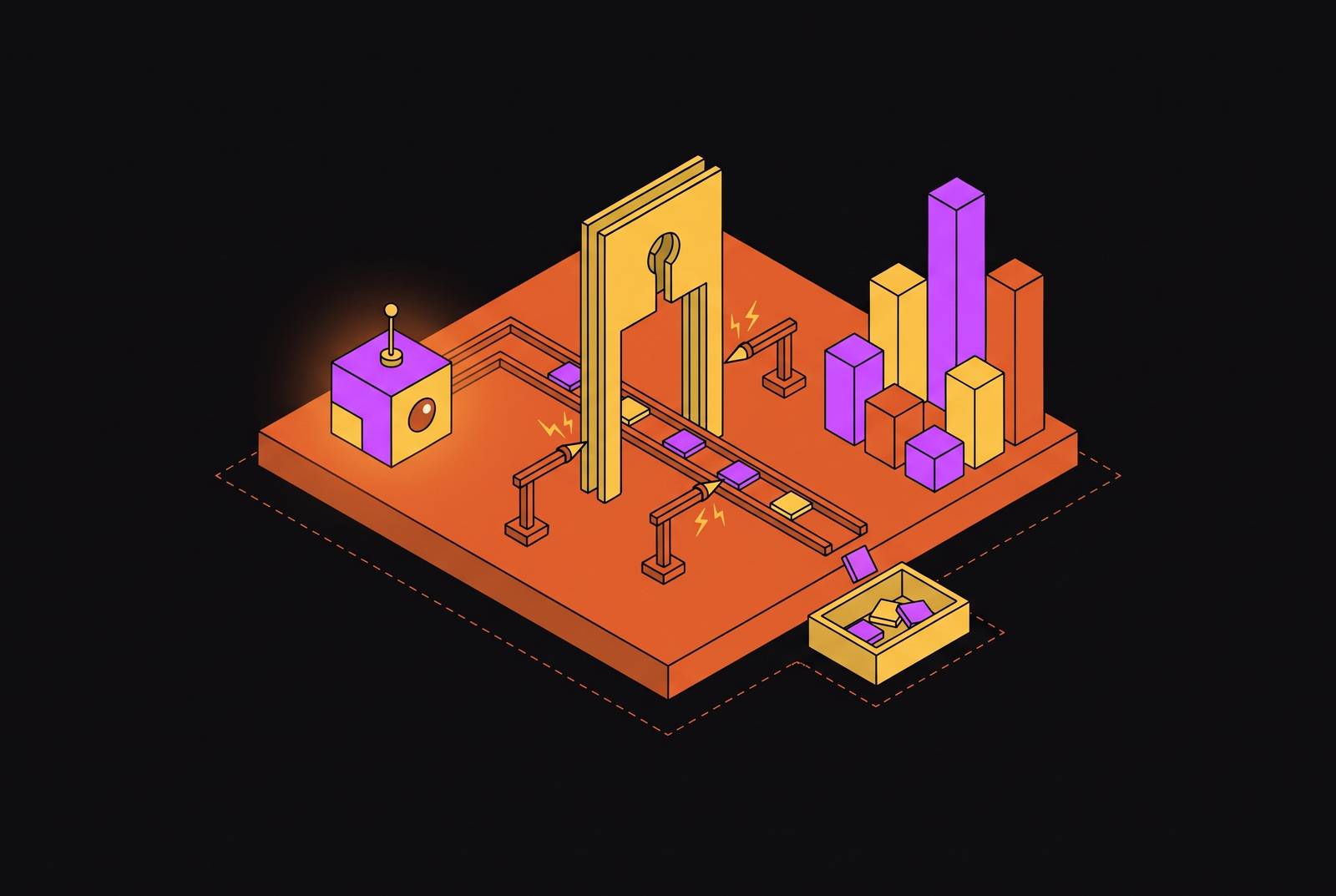
Testing a Kalshi bot before going live requires more than a winning backtest. The rigorous pre-live standard is grant-boundary fault injection, which tests whether measured edge survives order-grant limits, realistic fees, and adverse API conditions. Confidence comes from settled, out-of-sample evidence and traceable outcomes under those faults.
Why win-rate is the wrong pre-live gate for a Kalshi bot
“Mostly winning” appears to be a reasonable deployment threshold. A Kalshi bot can nevertheless win a clear majority of its trades and finish down money because transaction fees consume the margin on low-risk settlements. The apparent success and the financial loss are compatible. A passing win-rate therefore cannot establish that the strategy has a deployable edge.
Win-rate counts trades that win but does not show whether their margin covers the cost of trading. When fees are absent from the algorithm, the test omits a cost that the live strategy must bear. More winning observations cannot repair that omission, because they continue to measure the wrong economic proposition.
Automation can carry out a losing trade faster and more reliably while keeping a high win-rate. Deployment therefore depends on whether the bot’s probability estimates justify the prices it pays, after fees, and whether its controls preserve that advantage when execution departs from the expected path.
How do you test a Kalshi bot’s edge before going live?
A valid edge measurement compares the bot’s probability estimates with market-implied prices on settled, out-of-sample trades. The benchmark is the price available when the decision occurred. Settlement supplies the outcome against which the prediction is scored.
Brier score measures probabilistic accuracy as the mean squared error between predicted probabilities and actual outcomes, incorporating calibration and sharpness. Log-loss penalizes confident wrongness more heavily. Both assess the quality of the estimates. Edge versus book compares the bot with the market by taking realized win-rate minus mean implied price at the time of trade. A positive result indicates that the bot beat the book on that measure, while a result near zero indicates that it did not.
That comparison is not itself a fee-adjusted profit measure. Realistic fees still have to enter the economic test, particularly where the apparent advantage is small. The evidence must also remain forward-only. Only trades whose events resolved strictly after the bot traded count, while leakage and thin samples are quarantined rather than silently included in a favorable aggregate.
The grant boundary is the minimum measurable edge the bot must demonstrate before live deployment is rational. Operationally, it is where the evidence permits a trade, requires reduced sizing, or refuses exposure. This definition links prediction quality to the bot’s risk decisions. However, even a credible measurement describes past performance rather than future resilience, so the boundary must also be tested under conditions that can disrupt execution.
How the testing environment silently corrupts the pre-live verdict
Stateless mocks can make a sound metric appear trustworthy while removing the sequences that determine its validity. A fixed response to a fixed request has no memory of previous calls. Showing that order placement, partial fills, reconciliation, and drawdown halts work together in sequence requires tracking what happened earlier as well as whether each response has the expected shape.
AstroTick’s 434 tests passed with the Kalshi SDK replaced by a mock. In the dry run with an unregistered key, however, every cycle failed market discovery because MarketApi.get_markets rejected the _request_timeout argument AstroTick passed. The passing mock did not establish compatibility with the real SDK, and the failure occurred before the strategy could demonstrate successful market discovery.
Production responses can acquire fields before a sandbox reflects them, while rate-limiting behavior and webhook payloads can differ between environments. A sandbox pass then describes the sandbox’s behavior. It does not necessarily establish that the same sequence will work against the production API.
Kalshi’s demo environment documentation states that credentials are not shared between demo and production. A demo key works only against demo endpoints, and a production key works only against production endpoints. Credential mismatch is therefore a distinct failure mode. A bot that never tests it has left an authentication boundary outside its pre-live verdict.
These gaps can invalidate the grant boundary itself. A positive result obtained in a stateless or drifted environment may depend on behavior that the real integration does not provide. Stateful testing instead requires an order to remain present when read back, a fill to update the balance, and a cancellation to be reflected in the book. Each sequence must end in one traceable state.
The grant-boundary fault injection regime: what to inject and why
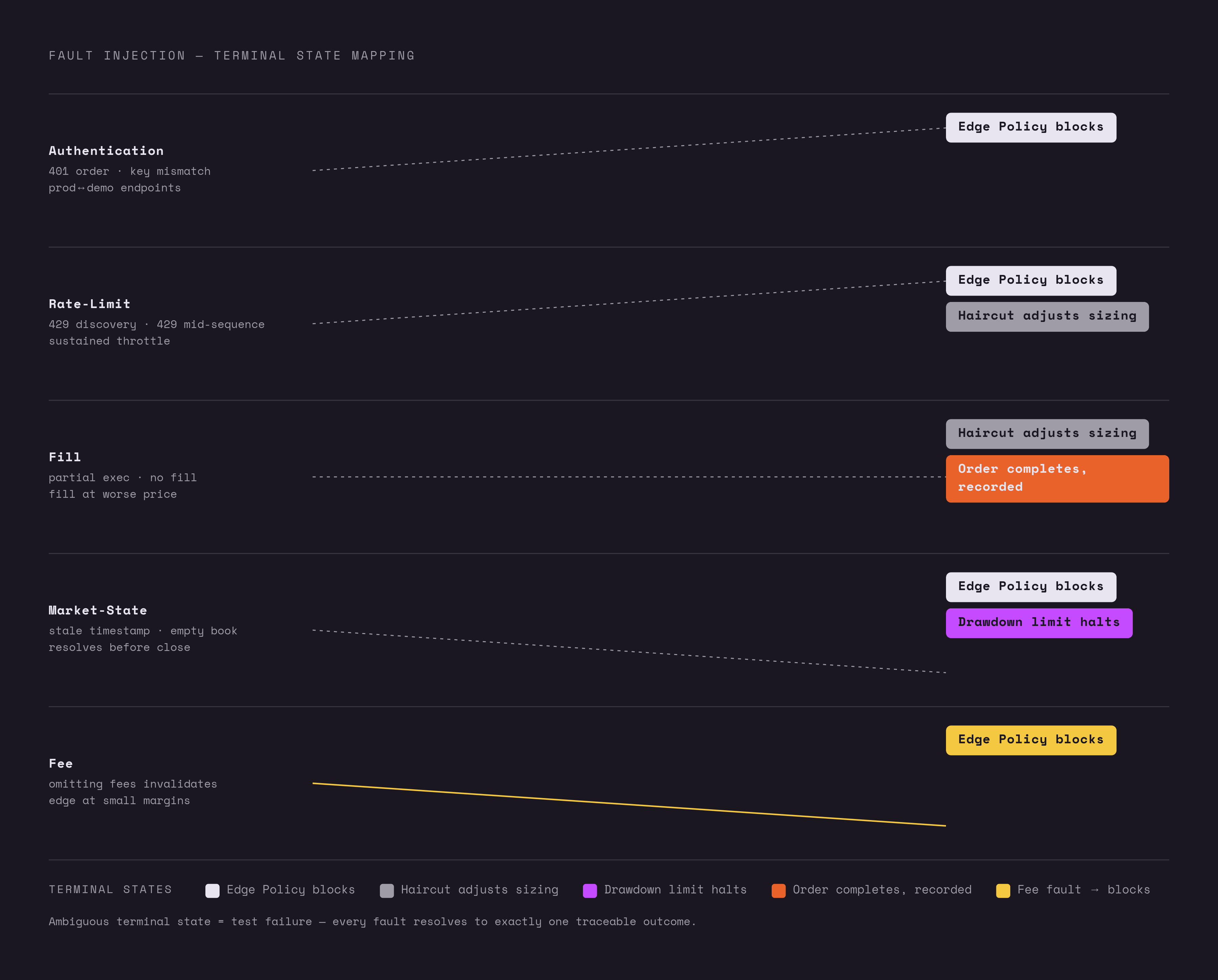
Grant-boundary fault injection requires a test for each known failure mode. The test injects the fault, requires the risk engine to reach a traceable final state, and records whether the measured edge survives. The tests cover order size limits, rate-limit thresholds, fee edges, and partial-fill conditions. Stale timestamps, empty books, and credential mismatches extend the same test to conditions where the bot’s permission to trade must be reconsidered.
Authentication faults include separate scenarios: a 401 on order placement, a production key sent to a demo endpoint, and a demo key sent to a production endpoint. The test must show how the risk engine ends the attempted trade when credentials or authorization fail. A nominally correct strategy cannot receive a passing operational verdict from an unresolved order attempt.
Rate-limit faults include a 429 during market discovery and a 429 during order placement mid-sequence. Sustained throttling also tests back-off and retry behavior. The interruption point changes the experiment. Discovery failure occurs at a different stage from throttling after an order sequence has begun, so a successful response to one does not establish correct handling of the other.
Fill faults cover partial execution, an order that receives no fill, and a fill at a worse price than the bot modeled. These scenarios test different departures from the assumed trade. Partial execution changes what actually occurred, while a worse price challenges the margin that justified the decision. The final record must distinguish the intended order from its recorded outcome.
Market-state faults include a market timestamp that is stale, an order book that is empty, and a market that resolves before the bot’s close logic fires. Tests of fee faults must use realistic costs whenever the margin is small. Omitting fees is itself a testing fault. A strategy cannot demonstrate resilience at its economic boundary if the environment removes the cost most likely to consume its apparent advantage.
Delivery faults cover out-of-order, duplicate, and missed events in event-driven integrations. PayPal and Stripe document these fault classes for their own APIs. The same classes belong in tests of an event-driven Kalshi integration, without assuming that those APIs have identical delivery behavior. The experiment must test the relevant event sequence rather than treating receipt of one expected payload as sufficient evidence.
For each fault, the acceptable result is a single traceable final state. The bot either blocked the trade through Edge Policy, adjusted sizing through a haircut, halted through a drawdown limit, or completed the order with a recorded outcome. Ambiguous terminal states are failures. That negative pre-live result is useful evidence. The suite is complete only when every fault class has produced a traceable final state.
Why stateful, continuously verified simulators are the right infrastructure for this regime
A simulator must keep state across calls because the fault regime tests how actions build on one another. Order placement, fill reconciliation, partial execution, and drawdown halts cannot be evaluated as unrelated responses. Earlier actions constrain later outcomes. A simulator that resets between calls cannot show whether the bot’s state machine reaches the correct terminal state after a sequence is interrupted.
Statefulness alone does not prevent API drift. A simulator matched to the live API once at build time can become inaccurate as that API evolves. The AstroTick argument mismatch illustrates the compatibility failure that a substitute environment can conceal, although it does not by itself establish when the mismatch arose. Verification before every release is the safeguard against allowing such differences to corrupt subsequent test results.
Fault injection must also be a first-class simulator capability. Latency, 429s, 503s, partial fills, and empty books must be configurable for each scenario and reproducible across runs. Reproducibility makes comparison possible. Without it, a changed outcome cannot be cleanly assessed against the same adverse conditions, weakening the deployment gate’s ability to evaluate a strategy change.
The starting state is part of that experiment. An empty environment can produce different bot behavior from a book with realistic depth and existing positions. Stateful transitions, current API behavior, and controlled faults must operate on a starting world that represents the conditions the strategy is meant to handle.
These properties allow the local test regime to run in CI on every strategy change. Agent training has the same underlying requirements. For RL environments and agent-native bots such as the ryanfrigo toolkit exposed through a tool interface, deterministic state, horizontal scale across containers, and controllable faults help align the training environment with the conditions the agent will face in production.
The self-correcting loop: from settled results to a tightened grant boundary
The grant boundary cannot remain fixed after launch because new settlements change the evidence behind it. In the ryanfrigo toolkit, cli improve pulls authoritative settlements, reconciles them into the decision journal, and re-derives Edge Policy from the whole settled record. A category is blocked while net-negative over at least 5 trades. The block lifts when settlements recover to break-even.
New block rules identify categories that the next cli trade refuses, while updated haircuts shrink overconfident estimate bands to calibrated win-rate. Recovered categories can have their blocks lifted. Each policy change becomes a fault-injection target because the revised permission to trade must work under adverse conditions.
The toolkit ships a “no edge” verdict on the operator’s own live account. A harness must be able to reject the premise that the strategy has earned permission to trade. Similarly, the account of autonomous operation after thousands of trades frames confidence as quantified risk.
Simulation fidelity nevertheless remains a legitimate objection. A strategy calibrated on past conditions may encounter a new fee structure, a new market type, or API behavior absent from its simulator. Continuous verification checks for API-side changes, but it cannot show whether the strategy will make money in the future. Forward-only measurement and minimum-sample gates prevent claims of calibration that the available evidence has not earned.
Earned confidence is therefore an auditable CI artifact connecting settled edge measurement, the derived grant boundary, and reproducible fault outcomes against a stateful, verified simulator. It must permit a negative verdict. As new settlements arrive, policy re-derivation changes the boundary and the next run tests those changes, so each deployment decision draws on a self-correcting loop.