Credential Scope Isolation as the Missing Layer in Kalshi Bot Staging Environments
Verifying account, budget, and permissions keeps Kalshi staging bots from touching production funds.
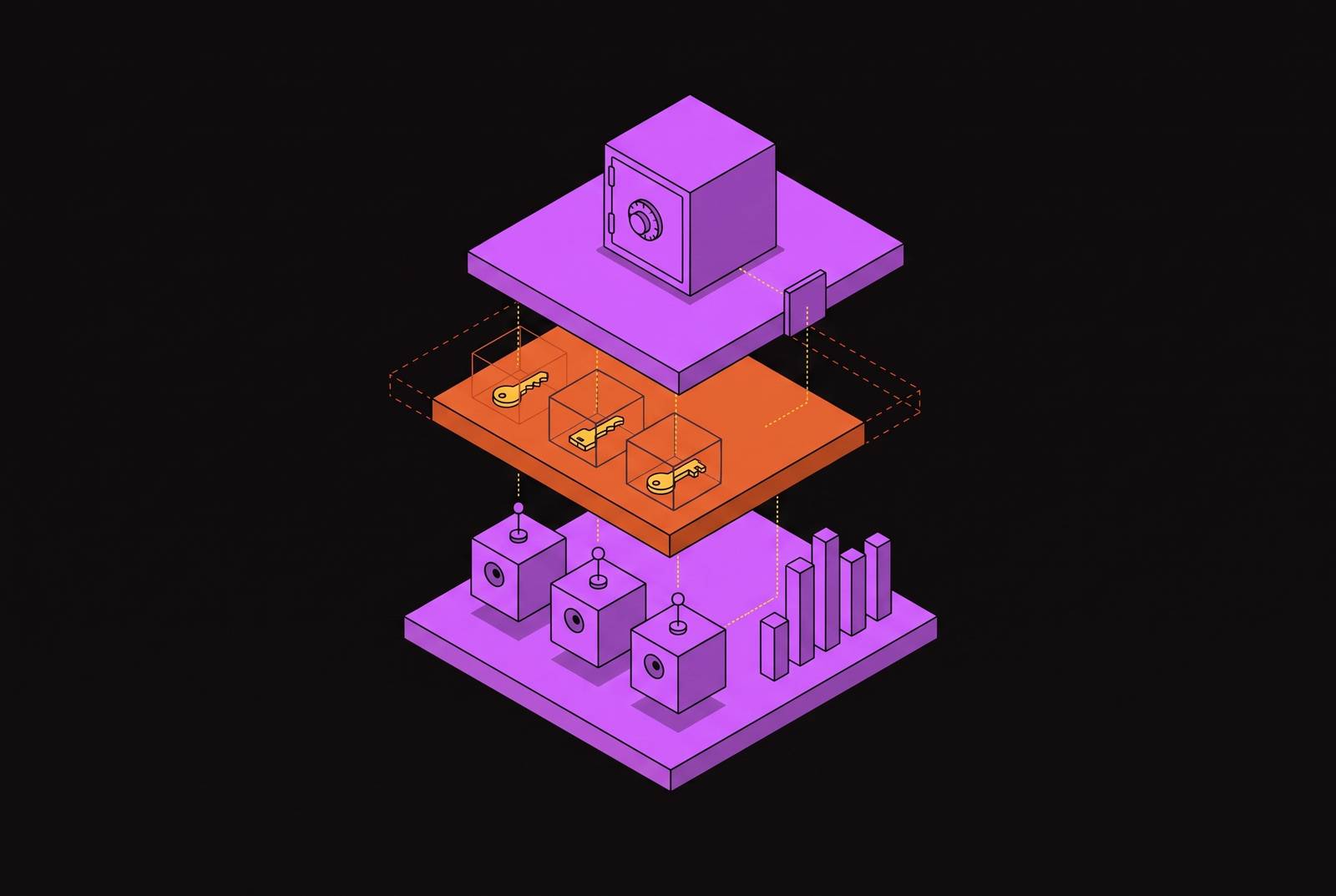
Testing a Kalshi bot before it goes live takes more than sending demo keys to demo endpoints. Credential scope isolation means verifying the staging account, budget period, and key permissions independently of endpoint authentication. A sound staging pipeline combines that ownership assertion with stateful simulation and fault injection, so dangerous order-flow failures can be tested without exposing the production spending pool.
Why routing demo keys to demo endpoints does not fully isolate a Kalshi staging environment
A developer wires demo keys to demo endpoints, puts the credentials in a separate .env, and marks staging as done. The configuration looks separate from production, and the routing may be correct. Yet the work has established only part of the boundary. It has not established which budget the credential resolves to, which operations it permits, or whether subaccount separation was enforced when the key was created.
Kalshi’s API environments documentation states that credentials are not shared between environments and that demo keys work only against demo endpoints. A demo key will be rejected by a production endpoint. The remaining concern is ordinary configuration error. A credential treated as a staging key can have broad permissions and an account binding that has never been checked against the intended staging budget.
The three distinct layers that "isolated" actually requires
Layer 1 is endpoint routing. It establishes that a credential authenticates only against the intended environment, with the API enforcing the distinction between demo and production keys. This is the boundary the environments documentation describes. A correct host and a successful authentication response therefore cannot stand in for the other isolation checks.
Layer 2 is budget scope. It establishes that the staging credential resolves to a spending pool separate from production, including the intended subaccount and budget period. Names do not establish that boundary. A key with “demo” in its name can still belong to the same account as a production key and draw on the same account budget. Until subaccount separation is confirmed, “routing-isolated” is the precise description, with “financially isolated” requiring that confirmation.
Layer 3 is key permission scope. It establishes that the credential permits only the operations required by the staging bot. All three properties must hold at once. Their numbers describe distinct boundaries, each of which remains equally urgent when another is completed. OWASP NHI8:2025, Environment Isolation in the Non-Human Identities Top 10, describes credential reuse across testing and production as an isolation risk. Kalshi’s authentication boundary addresses the cross-endpoint pattern, but endpoint separation alone does not establish the broader separation of identity, authority, and budget.
How budget-scope conflation happens in practice on Kalshi bot projects
The quickest way starts with an account that is already in use. A developer creates a demo key, copies its key ID and PEM into a staging .env, and configures the demo base URL. Each action serves a legitimate purpose. None, however, forces the developer to establish a separate budget or inspect the permissions attached to the key. Budget-scope conflation enters through that omission, without requiring a deliberate decision to share production resources.
The kalshi-interface reference project illustrates how separation appears in a repository. It uses separate api_keys/demo/ and api_keys/prod/ directories and an ENV=DEMO flag in .env. Those conventions distinguish files and select an environment. They do not prove which subaccounts own the keys or whether their permission scopes differ.
Permission scope can widen the same gap. A staging key created with broad write permission covers every write endpoint, while the narrower write::trade limits the authority needed for trading operations. The broader scope permits account-management endpoints that a staging bot has no reason to invoke. This is a mismatch between the bot’s purpose and the authority granted to its credential, compounded when the budget binding is also implicit.
What ownership assertion means and why staging deployments must fail closed without it
The operational control is an ownership assertion. Before a staging worker receives traffic, the deployment pipeline establishes which account and budget period its credential resolves to and rejects an unexpected result. Railway’s staging/production isolation guide explains that each environment has its own shared variables, so a project-wide API_KEY can have different values in staging and production. That convention separates configuration values, but it does not establish what the values authorize.
For a Kalshi bot, the assertion function belongs at boot, before any credentialed test suite or market-data processing begins. It calls a lightweight account-identity endpoint and compares the returned account identifier with the expected staging subaccount. A mismatch stops the worker with a non-zero exit status. The gate must also establish that the key has only the permitted scopes, such as read and write::trade, and that the account’s budget period is the staging period. Identity alone is not the complete assertion.
The gate must fail closed when those conditions cannot be established. Otherwise, an unavailable or incomplete check becomes permission to proceed with an unknown binding. The practical upgrade is to move environment checks out of comments, policy documents, and debugging routines and into deployment execution. The host that gets the request must match the credential’s environment, and checks of the account, budget, and permissions must confirm the other boundaries. No staging work should begin merely because a variable or directory says “demo.”
Why stateful simulation is the right foundation for the staging layer below that gate
A correctly scoped credential limits financial exposure, but it does not establish whether the bot behaves correctly. Kalshi order flows depend on prior events. A bot places an order, receives an order ID, checks its status, and may amend or cancel it after other state changes have occurred. Testing each request on its own cannot show whether the sequence works. The response to a cancellation depends on whether the order remains open or has already filled.
Stateless mocks serve a narrower purpose. Schema validators and static JSON fixtures can establish that a request or response has a known shape, but they do not maintain the order history on which the next response depends. A cancellation fixture cannot, by itself, distinguish an open order from a filled one. Stateful simulation preserves that distinction across calls. Its responses reflect the world as modified by earlier operations, so place, amend, cancel, and fill behavior can be exercised as connected transitions.
The ownership gate uses a real demo credential to check identity and scope, while the main suite of behavioral tests runs against a local stateful simulator. That simulator can be seeded with known market data, reset between runs, and driven into error states on demand. Reproducibility is the key benefit here. A demo-endpoint smoke test establishes authentication and payload compatibility, whereas the simulator tests how the bot responds to an evolving order state. Neither function substitutes for the other, and neither alone establishes the quality of a trading strategy.
Fault injection as a first-class concern in a Kalshi bot staging pipeline
A stateful simulator remains incomplete if every transition follows the happy path. Some dangerous failures return an ordinary HTTP 200 while leaving the bot with an incorrect understanding of its position or market. Transport success does not establish semantic correctness. A test suite that checks only status codes can therefore miss the corruption that influences the bot’s next trading decision. Fault injection must test how the bot handles those responses as well as requests that fail outright.
Write-endpoint tests should include 429 token-bucket exhaustion to exercise backoff and retry logic. Tests should also inject latency into order-status polling, because position-tracking loops need to handle timeouts when a status takes too long to arrive. These faults test different parts of the order flow. A delayed status response tests what the bot thinks has happened to an order, while an exhausted write allowance tests how it handles an operation it tries to perform. Both should be part of behavioral testing before demo smoke tests begin.
A response that omits a newly required field tests whether the bot stops or continues with corrupted position state. A stale order book tests whether pricing logic degrades gracefully. Neither case requires an obvious transport error. The simulator must make such conditions repeatable so that the suite can exercise the bot’s response to misleading data.
A bot with over-scoped production credentials that acts on a corrupted 200 response may place a real trade it was never supposed to place. Limiting what staging credentials can do lowers that risk, while a local simulator keeps behavioral tests from executing real trades. Fault injection creates dangerous conditions on purpose, and credential isolation keeps a mistake in the configuration from giving those tests production authority.
A concrete staging pipeline architecture that satisfies all three isolation layers
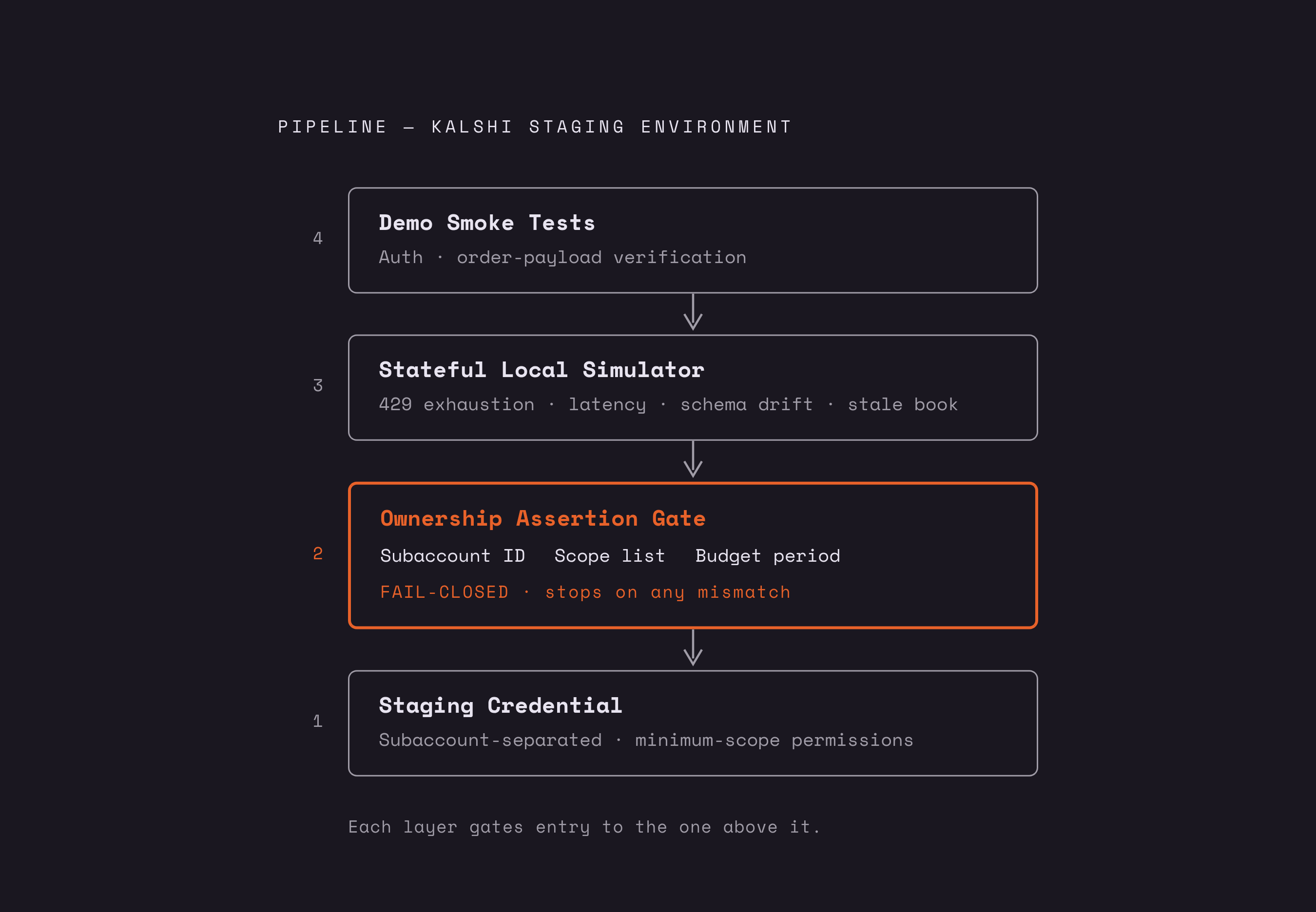
The reference architecture is a stack with four connected components. Its foundation is a subaccount-separated staging credential with minimum-scope permissions. Above that sits the fail-closed ownership assertion gate, which controls admission to credentialed staging work. The behavioral layer is a stateful local simulator, with fault injection shaping the conditions it presents to the bot.
Credential storage begins with separate paths for staging and production key IDs and PEM files. The reference project’s directory convention is a reasonable starting point, provided it is backed by subaccount separation. At boot, the gate compares the returned subaccount identifier with the expected staging identifier and checks the permitted scope list and budget period. Any failed assertion stops the process. The gate runs before credentialed tests and before the worker receives market data, so an unexpected identity cannot become an accepted runtime condition.
The simulator then supplies the order-state continuity needed by the behavioral suite. After placing an order, listing orders, and cancelling it, listing again should show the cancellation. Pre-seeded market data should exercise market-selection logic, and each run should be resettable to a known state. Pull-request CI runs this simulator with fault injection turned on. Those runs use no real credentials or demo endpoint calls and produce deterministic outcomes under 429s, latency, and schema drift.
Credentialed integration testing occupies a separate lane. A nightly or pre-release gate uses ownership-asserted demo credentials against the demo endpoint, with small order volume and smoke-test coverage only. Its purpose is authentication and order-payload verification. When the bot is deployed to production, the ownership assertion runs again to check for the expected production identity. Small real orders then check how execution works before the bot scales up.
A bot can work in the demo environment and still have no budget separation, permissions that are too broad, or tests that show how it handles failures. The ownership assertion is the linchpin because it binds the configured environment to the account authority actually in use. Without it, the simulator and fault tests may be well designed while the deployment boundary remains an assumption.