Simulating Okta Workforce Identity Flows in Local Development
Stateful simulation catches the sequential bugs hardcoded tokens and stubs let slip through.
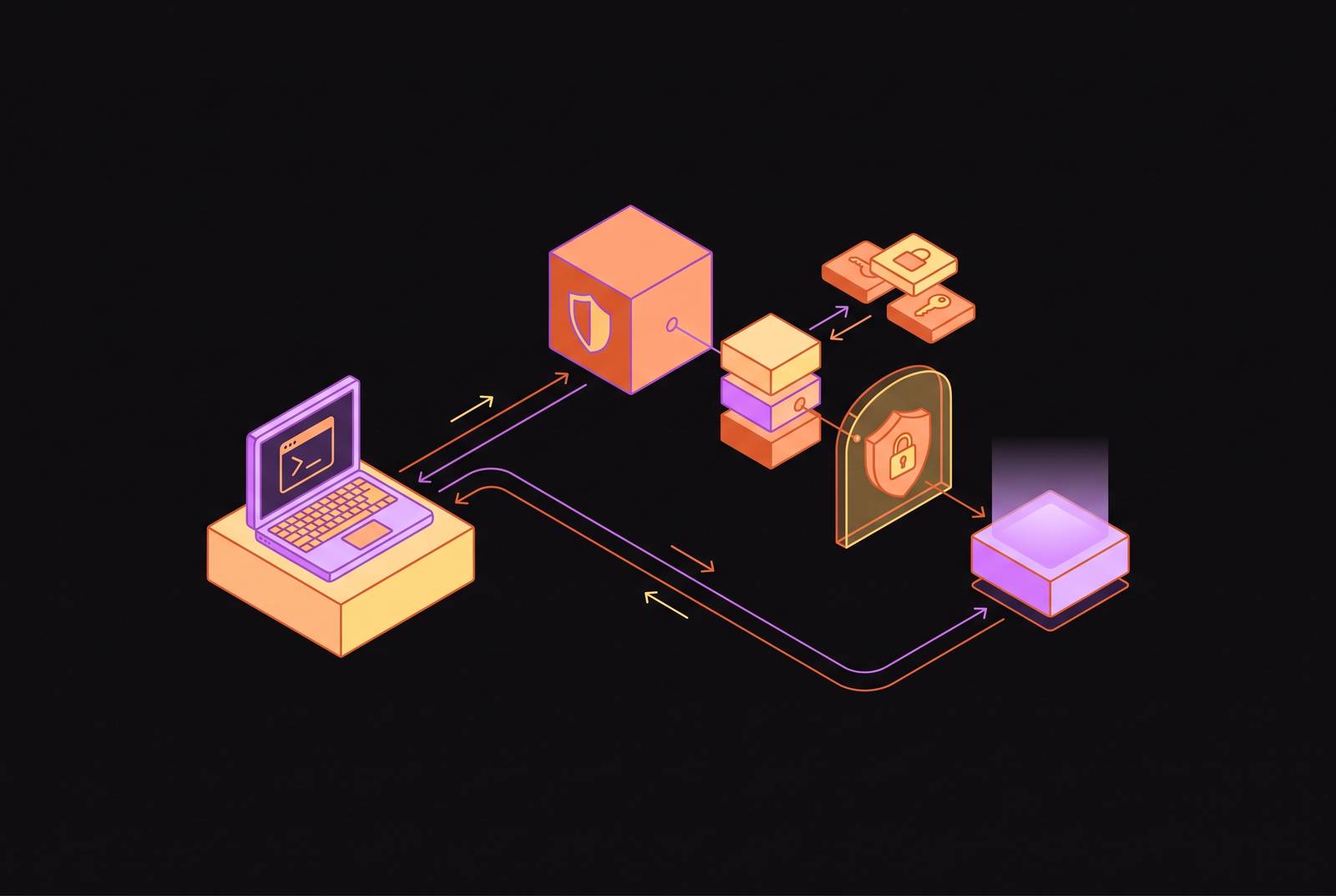
Okta Workforce Identity is a stateful, session-oriented identity platform where what happens on call three depends on what happened on calls one and two, and that dependency is the reason it resists the usual shortcuts.
Why Okta Workforce Identity flows are harder to simulate
Okta Workforce Identity Cloud bundles Single Sign-On, Adaptive MFA, device assurance, identity lifecycle management, and Identity Governance into one platform, and every one of those subsystems produces state that the next request depends on. A login isn't just a login: it sets an assurance level, starts a session clock, and records a device posture, and each of those facts has to be available to whatever call comes next. Okta's own platform documentation says its access policies are continuously enforced and monitored, and that tells you something important about the shape of the problem. The identity layer tracks device posture, session risk, and user context for as long as a session lasts, so it never evaluates each request on its own.
The target keeps moving, too. Okta Identity Engine is the authentication pipeline that drives all of this, and it's under active development. Its 2026 release notes show Cross App Access for AI agents heading to general availability in Preview, expected in Preview Orgs on August 17, 2026, along with MCP server securing and an extensible AI Agent Profile Schema. None of that is a settled API surface a developer can snapshot once and simulate forever.
The flows that cause the most damage in production, silent token renewal, session expiry, the 401-then-retry pattern, and single logout, are sequential by nature. What each step gets right depends on the state the steps before it built up. A simulator that doesn't carry that state forward can't produce any of these flows honestly.
Cross App Access adds a further wrinkle. Because admins approve that consent ahead of time, agents can now act for enterprise users without asking for consent at runtime, and Okta secures their identities through this mechanism. That's a machine-identity problem layered on top of the human one, and a stateless stub has no way to represent an agent's grant, let alone its revocation.
What developers do instead of proper simulation
Three shortcuts appear constantly in development environments: hardcoded stub tokens, auth middleware that gets switched off in dev config, and mock endpoints that return a 200 no matter what they're sent. Each one cuts away the exact spot where Okta integration bugs like to live.
If you hardcode a stub token, the application skips its own token validation logic. So issuer and audience checks never fire, and claims go uninspected, and the code looks fine until a real Okta tenant issues a token with a different claim set or a shorter lifetime in staging. Because development never asked the question, the failure appears later, not here.
Bypassing auth middleware in dev config has a similar cost. If the middleware is conditionally disabled, the 401-then-retry path, the refresh grant logic, and the session-expiry handling never run at all during development. They get exercised for the first time in production, which is the worst possible place to discover that the retry logic has a bug.
When a stateless mock always returns 200 on token requests, you get a particularly deceptive failure. Silent renewal logic looks like it works, because the mock never says no. The first time a real access token expires and the renewal call actually fails, the application has no tested recovery path, because nothing in development ever forced that failure to happen.
Using Okta's own trial environment doesn't solve this either. The Okta Workforce Identity Trial gives a developer full access to a demo environment for a limited period, which is genuinely useful for evaluating the product. It isn't built for the kind of repeatable, controllable integration testing where a developer needs to force a token to expire on demand, inject a 401 at will, or reset state cleanly between test runs. Token lifetime on a production tenant can't be dialed down to a few seconds, and without that control, renewal and expiry take minutes to become observable. That's too slow for a normal development loop, so the flows that matter most go untested because testing them properly takes too long. Integration bugs concentrate in the sequential flows that every shortcut skips, and the application that sails through the happy path can still crash the first time a long-running operation runs into an expired token.
The state an Okta simulation must track to be realistic
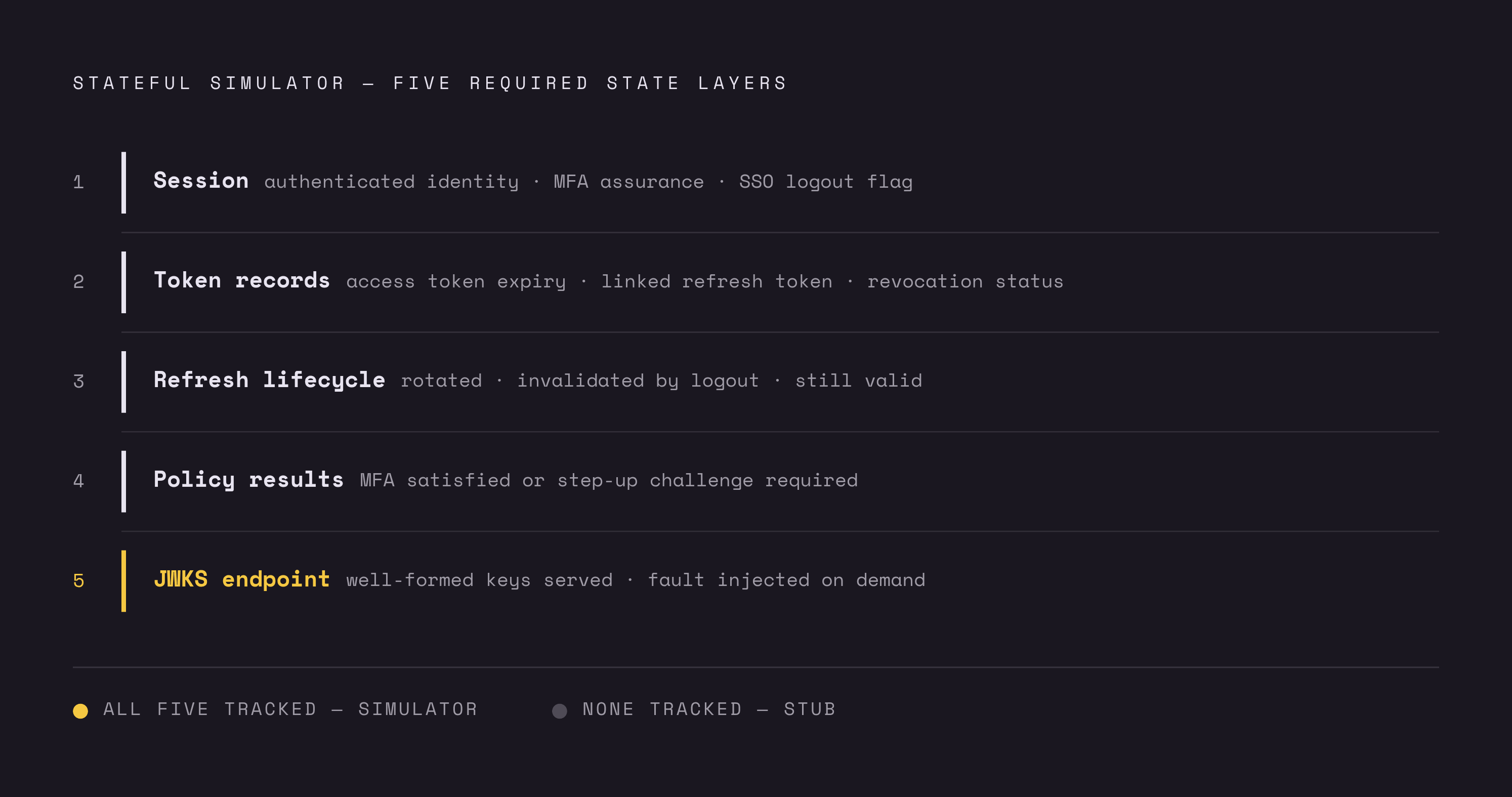
A simulation earns trust by maintaining a world that changes as calls happen to it. User session state, token issuance records, refresh token validity, device posture signals, and policy evaluation results all shift over time, and whatever call comes next has to see the current version of each, not a fixed snapshot from when the test started.
Session state needs to record which users are currently authenticated, when each session began, what assurance level it reached (MFA satisfied, device assurance policy passed, or neither), and whether single logout has already been triggered for that session.
Token records need to track every access token the simulator has issued, its expiry timestamp, its associated refresh token, and whether it has been revoked, so that a later introspection call or resource-server request against the simulator returns the right active-or-inactive answer.
Refresh token lifecycle tracking has to capture whether a given refresh token has already been consumed through rotation, invalidated by a logout, or is still good. A trustworthy simulator refuses a second use of a rotated refresh token the same way Okta does, because that rejection is itself the behavior under test.
Policy evaluation results matter because Okta's Adaptive MFA decides on step-up based on device and user context. A simulator needs to know whether MFA has already been satisfied for the current session, so a protected resource call either succeeds outright or correctly triggers a step-up challenge depending on that state.
JWKS endpoint state rounds out the list. The simulator has to serve a well-formed JWKS so applications doing local token verification can succeed normally, and it has to support injecting a JWKS-unavailable fault on demand, so the application's handling of that specific failure gets tested.
None of this is exotic, but taken together it describes a genuinely different kind of tool than a request-matching mock. A simulator that tracks all five of these categories is one a developer can trust to represent what Okta is actually doing. One that tracks none of them is a stub wearing a simulator's name.
How stateful simulation enables sequential flows
Once a simulator remembers what happened on the last call, the three flows that matter most, silent token renewal, session expiry with forced re-authentication, and 401-then-retry, stop being theoretical and become things a test suite can run in seconds.
Silent renewal looks like this in sequence. The simulator issues an access token with a short, configurable lifetime. The client SDK's silent-renew logic fires on schedule and hits the simulator's token endpoint with the refresh token. The simulator checks that refresh token against its own state, confirms it hasn't already been consumed and that the session is still active, issues a new access token, rotates the refresh token, and records the new pair. A second attempt to use the old, now-rotated refresh token has to fail, because the simulator's state shows it was already consumed. A simulator without memory of the first exchange either accepts the stale token on the second try, which hides a real rotation bug, or rejects every refresh request outright, which makes the whole flow impossible to test.
Session expiry with forced re-authentication follows a different sequence. The simulator can advance its internal session clock, or it can accept a direct test-control call that marks a given session expired. The next resource call against that session then gets back a 401 with a session-expired error body. The application is then expected to redirect to the authorization endpoint, complete a fresh login, and resume where it left off. The simulator can confirm the application actually did a full re-authentication before issuing it a new session.
The 401-then-retry flow depends on the same memory. The simulator returns a 401 on the first resource call, because the token behind it is expired or revoked, the application exchanges its refresh token for a new access token, and the retried resource call succeeds. A stateless stub that answers every token request with 200 never surfaces this flow, because the flow only exists when the simulator can distinguish tokens it has issued from tokens that have since expired.
Single logout works the same way. A stateful simulator marks a session as terminated the moment logout happens and returns 401 on any later request carrying a token from that session, which matters for any application that has to handle a forced logout triggered by a security event.
Shortening token lifetime to a few seconds inside the simulator's own configuration is what makes all of this fast. Renewal and expiry scenarios that would take minutes to observe against a real tenant become deterministic, repeatable test cases, and no production tenant or trial environment is built to let you do that.
Fault injection scenarios specific to Okta identity flows
Correct behavior on the happy path only covers part of what an identity integration needs to survive. Real resilience depends on a simulator's ability to inject specific failures on command, because expired tokens, revoked sessions, and an unreachable JWKS endpoint are distinct failure modes, and each one needs its own test.
A JWKS endpoint going unreachable is one of the more consequential cases. Whether the application fails closed and rejects all requests, or fails open and starts accepting tokens it can no longer verify, decides whether the failure stays safe or becomes a breach.
A token revoked mid-session is tested by having the simulator mark a token revoked through a test-control API, so the next introspection call returns active: false. The test then checks whether the application notices and re-authenticates the user, or keeps serving them with a token that's no longer valid.
MFA step-up challenges get tested by having the simulator return a 403 with an MFA-required error on a specific resource scope, checking whether the application redirects into a proper step-up flow instead of showing the user a generic, unhelpful error.
Device assurance failures work similarly: the simulator returns an authentication failure citing unsatisfied device assurance, and the test checks the application's degraded-access or remediation path.
Rate limiting deserves its own scenario because Okta's token endpoint is rate limited in production. Injecting a 429 with a Retry-After header checks whether the application backs off the way it should, rather than hammering the endpoint repeatedly and risking a lockout.
Cross App Access introduces a newer case that is worth testing directly. If an AI agent's permission grant gets revoked mid-workflow, it is expected to receive a 403 and stop. That expectation can only be tested when the simulator tracks which agents currently hold active grants and can revoke one on demand, which is a direct consequence of how Cross App Access is built: consent is pre-approved by admins, not negotiated at runtime, so revocation has to be a deliberate, trackable state change.
Local simulators in the CI/CD pipeline alongside Okta's own environments
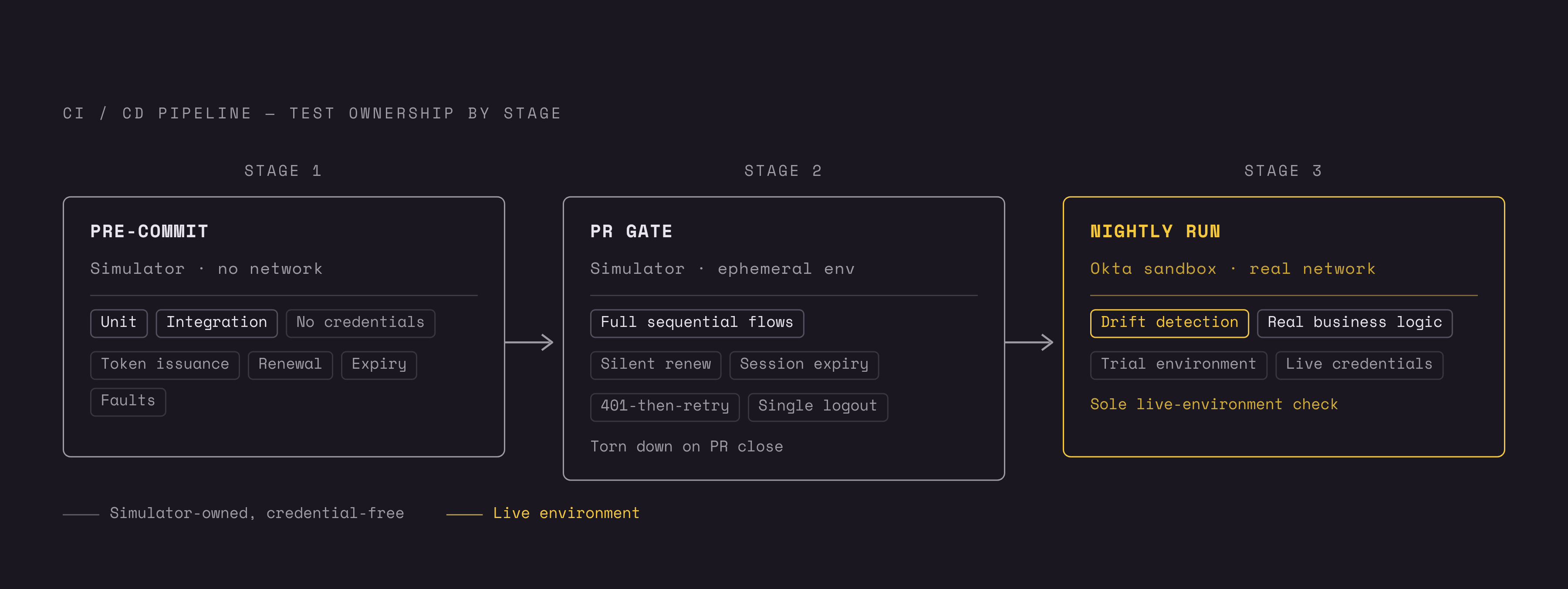
A stateful Okta simulator belongs at the pre-commit and PR-gate stages of a pipeline. It isn't meant to replace Okta's own environments everywhere, but at those two stages, it's the only option fast, deterministic, and safe enough for the kind of sequential flow testing identity integrations actually need.
At pre-commit, unit tests run alongside simulator-backed integration tests covering token issuance, renewal, expiry, and the fault scenarios above, with no network call to a real Okta tenant and no credentials needed.
At the PR gate, the full sequential flows get exercised: silent renew, session expiry, 401-then-retry, single logout, all run against the simulator inside an ephemeral environment created for that pull request. Tearing that environment down when the PR closes keeps one test's state from leaking into the next, which also makes it safe to run destructive tests like token revocation or session termination without worrying about side effects on other work.
A scheduled nightly run is where Okta's own trial or sandbox environment comes in, exercising real network behavior and Okta's actual business logic. This is the stage that confirms the simulator hasn't quietly drifted from what Okta actually does.
Running everything against Okta's live environments, at every stage, creates problems that have nothing to do with correctness. Live third-party environments can trigger rate limits, cost money per run, and introduce network latency that makes tests flaky, and none of that is tolerable at the pre-commit or PR-gate stage, where speed and determinism are the whole point.
Wherever a pipeline stage does touch a live Okta tenant, short-lived federated credentials are the safer choice over long-lived static API keys. The simulator stages need no live credentials at any point, so this question never comes up for them.
This tiered structure resolves what looks like a disagreement between local simulation and live sandbox testing but is really a division of labor. Simulators own the fast, deterministic inner loop. Live environments own the slower, scheduled outer loop. Production synthetic monitors catch whatever slips past both.
The drift problem: keeping a simulator honest as Okta's API evolves
If a simulator goes unverified against the live Okta API, it will drift from what Okta actually does, and the confidence it provides turns into a liability the moment it stops matching reality. Verification against Okta's live environment has to be a standing engineering discipline rather than a one-time setup step, with the nightly run against Okta's trial or sandbox environment serving as the mechanism that catches drift before it reaches a developer's test suite and quietly convinces them that broken code is working.